|
The Ouse Valley Railway was built for a unique reason.
Not like all other railways to transport passengers or goods from a to b, but to
stop the London Brighton & South Coast Railway's competitors' from
getting a foothold in this part of rural Sussex! The idea was simple, start to
build a railway, but build it as slowly as Parliament would permit, and the
"opposition" would look elsewhere when deciding where to build their next
railway! There were other legal reasons why once one Company had started to
build a line to serve an area then others would find it well nigh impossible to
get an Act serving the same area passed by Parliament.
It is perfectly true to say that had the Ouse Valley Railway
opened then the Lewes extension to the London and East Grinstead Railway would
have never been built. That became The Bluebell Railway!
Can we also point out that what you see on the ground is
really a work in progress. When the railway was abandoned it was left as is,
nothing was tidied up. In other words it was common to get the embankments up to
a level where temporary rails could be laid so that spoil could be transported
from one work site to the other and then tidy the whole thing up later. There
are for example holes in the ground (now full of water or buried under thick
vegetation) that would no doubt have been filled in later. Some of the
embankments were no doubt to be widened once more spoil was available from work
elsewhere. This also helps explain why some of the cuttings seem wider than
needed, together with the fact that the soil in this area was quite unstable
making the slopes less steep than in other areas.

The Western end of the line runs in a very gentle curve just
under two miles long between the two red Xs. The roads at the bottom of the
picture are Lindfield near Haywards Heath, Sussex.
On the LBSCR, London, Brighton & South Coast Railway network
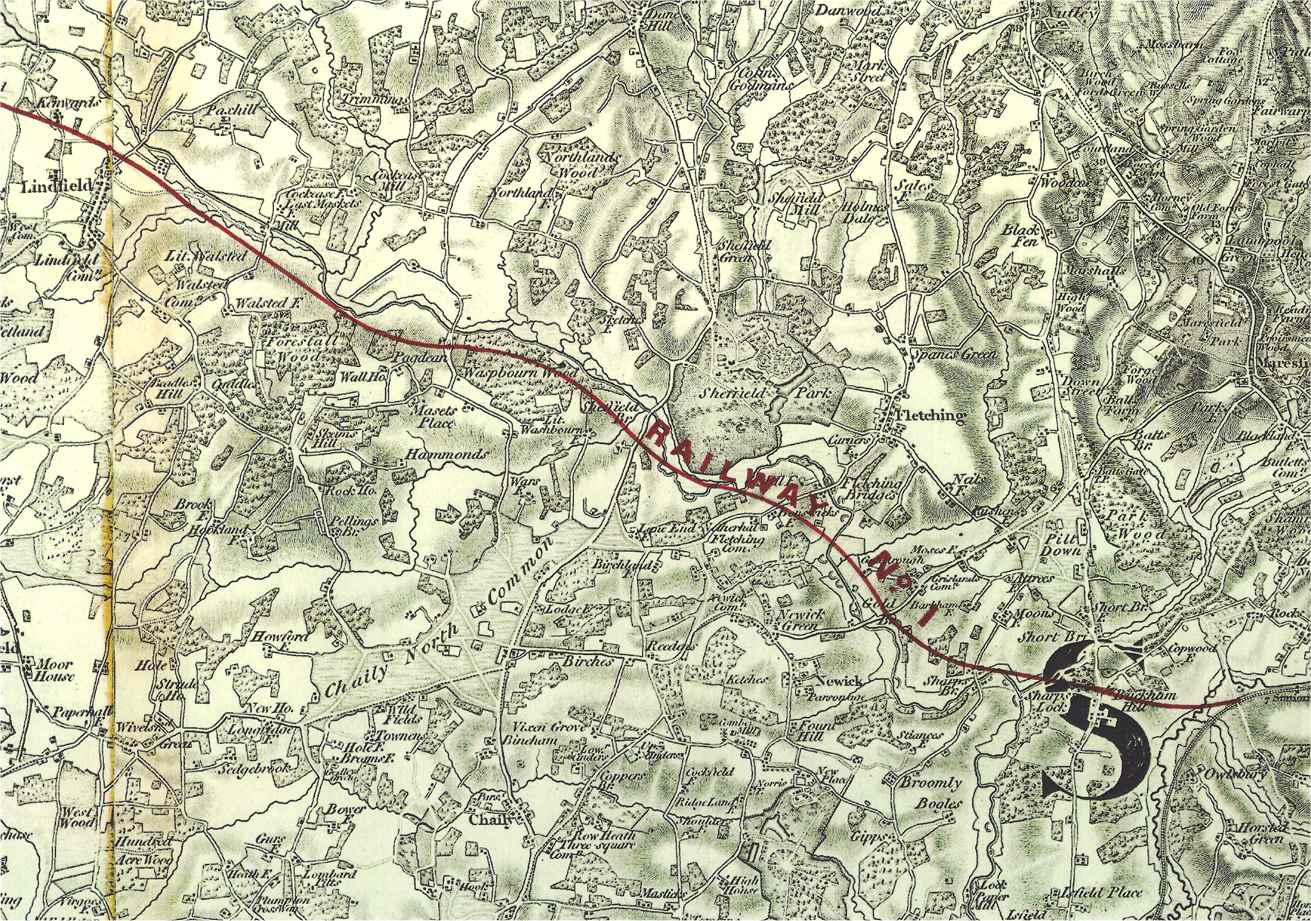
the least known line is the mysterious Ouse Valley Railway (also known as the
Ouse Valley Line) - started yet never finished. No trains proper ever ran along
its 20 miles of lines yet some say they can still hear the loco whistle! This
railway line was supposed to run from a new junction with the London to Brighton
line through Lindfield and then on to Sheffield Park and ultimately Uckfield in
Sussex. There were even plans for the line to continue to Hastings. Had the
"Ouse Valley Line" been finished it is almost certain that the East Grinstead to
Lewes line (which of course became "The Bluebell Railway") would have never been
built. Construction stopped abruptly after floods had delayed work in February
1867 and the landscape has remained unchanged ever since. Even so, the few
traces that still exist some 135 years later are rapidly returning to nature so
we show here some photos of the line taken in January 2003. How much of this
will still be there in another 100 years? Nothing is our guess! Click any photo
on the page to view the un-retouched original which exceptionally MAY be
published as long as due acknowledgement is made to the copyright holder -
horstedkeynes.com. As another exception to the rest of this web site these
pictures are little compressed to show as much detail as possible, this page
will therefore take some considerable time to load.
Excellent quality 1947 aerial photographs of the Western
end of the line can be found
here and
here.
Authorisation for the building of the "Ouse Valley Line" was
given in 1864, the enabling act being [(c.cxxxv),
s.25; L.B. & S.C.R.(Ouse Valley Line) 1864 (c.cxxiii),] The line was to
start at a new junction with the existing London to Brighton line
immediately South of the Ouse Valley viaduct. At the first over bridge just by
here you can see two wide walls which were built to hold a new over bridge next
to the bridge in the distance which carries the main London to Brighton line.
These are very substantial as they supported a temporary way on a wooden bridge
during the construction of the line. Surprisingly although the bridge is within
a few feet of the junction, the temporary wooden structure never
carried any connected running rails as the spoil from the building of the tunnel along the line
never quite reached here. Construction actually stated at a point a mile or so
away from here towards what is now Haywards Heath Golf Club. This was a common
method of building railways in those days. Where you or I would start at one end
and then build away from an existing railway, they would start and build a camp
where the most spoil was available and work out from there. This explains why
the earthworks shown below do not always connect to each other. A contractor's
locomotive would be manhandled to this point and would transport the earth to
where it was needed using a temporary line. This explains why the rails
on regular railways are often referred to as a permanent way!

From here the line travelled over some quite serious
earthworks now hidden in thick woods, some of the spoil came from the earthworks
at Kenwards Farm. Other came from natural deposits now one the area of the golf
course. Despite visiting in the depth of winter we
were unable to take any meaningful pictures here although the course of the line
could be walked by a determined investigator (with the landowners permission of
course). The earthworks are at least 60 feet high in places and are just as
intrusive as those on the main London - Brighton line built some 30 years
before, so great care would be needed. If we do manage to find a clear spot for
photography then pictures will certainly appear here in due course.

The photo above is near the end of the first of these
earthworks where the line crossed a lane by substantial skew over bridge the
remains of which are shown below. As you can see some of the spoil for these
monds came from the hole in the ground now filled by water! There are still brick courses to be seen here
built to hold back the embankment at the site of the new bridge which remained
as an obstacle to traffic on the lane for many years until being demolished in
the last years of the 19th Century.

The above photo is somewhat misleading as this is the second
embankment on top of a lower one making the rail height about 20 to 25 feet (6
to 8 metres) above road level.
After this bridge there are yet greater earthworks where the
line curves gently left around what is now the Haywards Heath Golf Course.
Despite trying for hours to find a place to photograph these earthworks because
of the heavy wood there they
just don't show on a photo, we are still looking.
The line then enters the start
of a very short but deep cutting into where a tunnel would have been built which
we shall call "Kenwards Farm Tunnel" after the farm near where it would have
emerged.


The trees in the centre of this picture show the brow where
the Eastern end of "Kenwards Farm Tunnel" would have emerged, just below where
the lane meets the trees. The land in the foreground would have been cut away to
a depth of perhaps 80 feet or more and the line would have been at the level of
the dip in the lane. Kenwards is to the immediate Right of this picture.
(Insert) A VERY rough idea of how the land might have looked had the tunnel
been built. The straight tunnel, perhaps 60 feet long, is in the FAR hillside
and the photo would have been taken from a mythical underbridge some 50 feet
above rail level and a few feet from the front door of Kenward's Farm!
(Picture taken with permission of land owner)

We are now beside Kenwards Farm itself which would have been
left on the edge of a deep cutting had construction continued for just a few
more weeks. This would have severely altered the grounds of this beautiful
Sussex farmhouse. Fortunately excavations just by the farm were not started and
the part of the cutting that had been built nearest the house has been dammed
and turned into a lake. Shown above is the lake taken from Kenwards looking East
which shows the depth of the earthworks these would of course have been at the
depth of the bottom of this lake! (Picture taken with permission of
land owner)

The cutting itself taken in poor light but still showing the
depth of the cutting below the lake at Kenwards. The embankment on the right,
Southern, side is perhaps 60 feet or more. (Picture taken with permission of
land owner)
Some three miles from the London-Brighton Main Line junction
we are now approaching the site of Lindfield Station where the line would have
crossed the London turnpike. Just before we get there however there is the site
of another set of earthworks each side of Spring Lane. The first picture shown
below is to the West and the second is on the East side of where a small
occupation bridge was built to serve Spring Lane. The main point of interest is
that the earthworks come to an abrupt stop in the middle of a field! Again the
earthworks are quite substantial and would have been built from the spoil gained
from the cutting at the entrance to the proposed tunnel under Kenwards Farm.
Further extension of the earthworks would have had to await the construction of
Kenwards Farm tunnel itself which of course never happened. It is interesting
that despite almost a century and a half having passed only the bridge has
disappeared, none of the soil has been removed to build up nearby fields as the
earthworks must get in the way of farm operations.

West of Spring Lane taken from the North side the embankment in the distance
follows the tree line parallel to the electricity lines.

The odd clump of earth to the East side of Spring Lane which just stops right
in the middle of a field!
The height here is between 15 and 20 feet (5 and 6 metres).
 |
A feeling of scale is shown here at the site of
the over bridge to the left of the above picture.
The line was apparently built for single track working here. |

Just how much green would still be visible had a station been
built beside this road is anyone's guess! The line would have crossed in the
foreground of this picture where a bridge caused traffic congestion for some
years. The thick tree stump on the centre right foreground is now supporting
some of the old brickwork shown below. To the left the earthworks just stop
again after a few dozen yards where a bridge would probably have crossed
the river Ouse (not for the only time we would guess!) Interestingly the
earthworks here are much wider suggesting a double track layout for Lindfield
station which would have been on the Eastern side of the turnpike near Dean's
Mill where a plot of land had been purchased.

The same trees stump on the top left of the picture above at
the proposed site of Lindfield station helps hold back some brickwork of the
demolished Lindfield over bridge. The remaining brickwork on the other side of
the road above (actually the Eastern side) was removed many years ago to ease a
dangerous curve on the steep hill. The bricks from here hold up many of the
borders in nearby gardens! Nothing else of this strange line is visible until
the we approach Uckfield more than 12 miles distant.
Now to the other end of the line at Uckfield.

Our first picture of the Eastern end shows an overhead view
of the substantial earthworks that are still in situ. They stretch in a smooth
arc between the two red Xs. Interestingly the length of the earthworks is almost
to the inch exactly one mile! Whether a contractor was hired to dig for exactly
this length and they stopped as soon as possible I don't know but it is an
interesting fact none the less. The part of the earthworks to the Western end in
the thick wood are a deep cutting which is not easily seen from above. After
careful consideration we have decided to ignore the ploughed field where two
white "blobs" are visible. It is possible that some earthworks were here but
have been filled in.
A further set of pictures of the ground features of the "other" end of the line near Uckfield will appear here soon but in the mean time if you have any questions
about the railways around Horsted Keynes please do get in touch by 'phoning or
email the webmaster. A recently made home video lasting
well over one hour and showing all the remains of this line can be obtained from
www.dumpman.co.uk. Whilst this is very
interesting and is recommended we would suggest that if you want to avoid nausea
you only watch in short spells as the film maker does not seem to possess a
tripod which means that the pictures are very shaky indeed. Pity as he is happy
to go where others fear to tread!
|